The Blind Watchmaker
Why the Evidence of Evolution Reveals a Universe Without Design
In The Blind Watchmaker, Richard Dawkins challenges the 'Argument from Design'—that complex organisms must be designed by a creator, just as a watch implies a watchmaker. Dawkins argues that natural selection, though blind and directionless, is capable of generating immense complexity through the cumulative selection of small, random mutations over vast periods of time. It is nature's 'blind watchmaker'.
Explaining the Very Improbable
Dawkins first acknowledges the astounding complexity of living organisms and introduces William Paley's 'watchmaker' analogy. He notes that organisms do indeed appear to be designed, but we need a natural explanation.
Read More→Stone
Simple, Natural
Watch
Complex, Designed
Eye
Complex, but... Evolved
Good Design
Using bat echolocation as an example, this chapter details the exquisite adaptations that exist in nature. This 'good design' has evolved to solve specific survival problems (like navigating in the dark).
Read More→Move Mouse to Echolocate
Accumulating Small Change
Explains the difference between cumulative selection and single-step selection. The 'Biomorph' program demonstrates how simple rules and random variations can produce complex forms through cumulative selection.
Read More→Biomorph Laboratory
Artificial selection of evolving tree-like forms. Click offspring to breed new generations.
Making Tracks Through Animal Space
Explores how evolution navigates through all possible biological forms. Evolution is gradual - each step must be viable, and each step must usually offer some advantage over the previous one.
Read More→The Power and the Archives
Discusses DNA as the carrier of information. Genes are replicators, preserving the 'wisdom' of evolution.
Read More→Origins and Miracles
Explores the origin of life problem. While the origin may be an extremely low-probability event, across vast timescales, it becomes not only possible but almost inevitable.
Read More→The Probability Filter
Even if the origin of life is an extremely low-probability event (like one in a billion), across vast timescales and the breadth of the universe, it becomes almost inevitable.
Constructive Evolution
Discusses coevolution and 'arms races'. The interaction between predators and prey drives an increase in complexity, though this doesn't necessarily mean long-term progress - sometimes it's just to maintain survival.
Read More→Arms Race
Notice how both evolve in tandem. If one evolves faster, the other must keep up to survive. This leads to constant improvements in both capabilities, even if their relative positions may remain unchanged (Red Queen Hypothesis).
Explosions and Spirals
Explores sexual selection and runaway evolution (like the peacock's tail). Sexual selection can lead to extreme development of certain traits, even if they're detrimental to survival.
Read More→Sexual Selection Balance
Punctuating Punctuationism
Discusses the 'punctuated equilibrium' theory. Dawkins argues this isn't a rejection of Darwinian gradualism, but merely a change in rates.
Read More→Gradualism vs Punctuated Equilibrium
The One True Tree of Life
Uses molecular biology evidence (such as DNA comparison) to reconstruct evolutionary relationships, proving that all life stems from a single ancestor.
Read More→Doomed Rivals
Refutes other evolutionary theories besides natural selection (such as Lamarckism and mutationism), arguing that natural selection is the only viable theory for explaining complex adaptation.
Read More→Lamarckism
REJECTEDAcquired traits cannot be inherited
Mutationism
REJECTEDMutations are random, not directed
Creationism
REJECTEDLacks evidence, unscientific
Natural Selection
ACCEPTEDThe only viable explanation
Core Demonstration
Experience the power of cumulative selection firsthand.
Climbing Mount Improbable
Evolution is like climbing a mountain. If we try to reach the summit in one step (single-step selection), that's impossible - just sheer cliffs. But if you go around the back of the mountain, walking up gentle slopes one step at a time (cumulative selection), you can eventually reach what seemed like an impossible peak.
Weasel Program
Dawkins' famous demonstration of cumulative selection. Watch as random mutations gradually evolve towards a target phrase.
Evolution of the Eye
Light-Sensitive Spot
A simple patch of light-sensitive cells. It can distinguish between light and dark, helping the organism detect predator shadows.
Curved Cup
The light-sensitive patch curves inward into a cup shape. This allows the organism to determine the direction of light sources.
Pinhole Camera
The opening narrows. This forms a rough image on the retina, similar to a pinhole camera, improving resolution.
Lens Formation
Transparent fluid fills the cup, and a lens evolves to focus light. This greatly sharpens the image and increases light sensitivity.
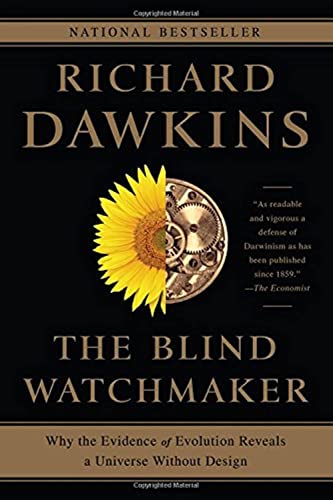
EVOLUTIONARY MASTERPIECE
THE BLIND WATCHMAKER
Discover the elegant simplicity behind nature's complexity. Witness the evidence that reveals evolution's blind architect.
Recommended Reading
The Selfish Gene
Richard Dawkins
>Dawkins' most famous work. It shifts the focus of evolution from the organism to the gene, providing the necessary context for understanding the 'blind watchmaker' mechanism.
Darwin's Dangerous Idea
Daniel Dennett
>A philosophical exploration of natural selection as a 'universal acid' that eats through traditional concepts of design, purpose, and meaning.
Climbing Mount Improbable
Richard Dawkins
>A direct follow-up to The Blind Watchmaker. It focuses specifically on how gradual evolution can produce seemingly impossible complexity, like the eye or the spider's web.